
The Skyscraper Technique in Sudoku
What Is a Skyscraper?
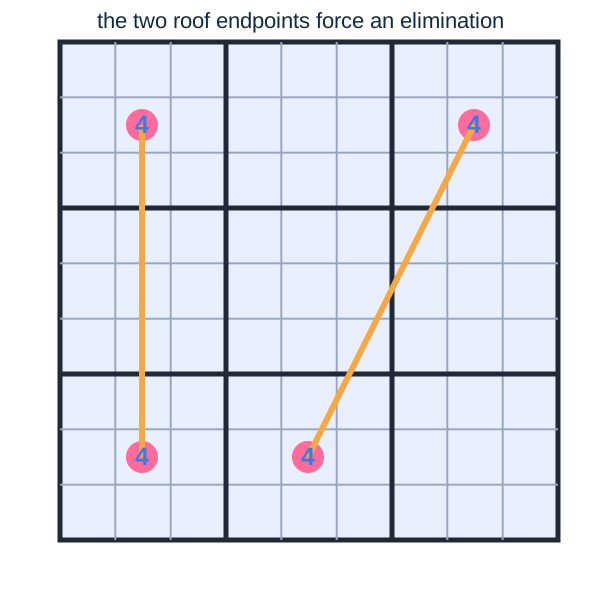
Skyscraper is a single-candidate pattern built from two strong links in two different rows or columns. For a chosen digit, each base unit contains exactly two possible positions. One candidate from each pair forms a shared base relationship, while the other two candidates are the endpoints, or the “roof” of the pattern.
The two roof candidates cannot both be false. If one roof candidate is false, the strong link in its base unit forces the other candidate in that unit. The shared relationship then forces the opposite roof candidate. Because at least one roof must be true, any cell that can see both roof candidates cannot contain the chosen digit.
How to Find a Skyscraper
Use this checklist:
- Choose one candidate digit.
- Find two rows, or two columns, where that digit appears in exactly two positions.
- Identify one candidate from each pair that can see the other, forming the shared base connection.
- Treat the remaining two candidates as the roof endpoints.
- Find cells that can see both endpoints and remove the chosen candidate from them.
The pattern can be rotated or reflected. The two base units do not have to be adjacent, and the endpoints do not need to lie in the same block. What matters is the strong-link logic and the shared visibility at the base.
Why the Elimination Is Valid
Imagine candidate 4 has two possible positions in each of two rows. If the lower candidate in the first row is false, the upper candidate in that row must be 4. Through the shared base relationship, this forces the corresponding candidate in the second row, which in turn makes the second roof true. The same reasoning works in the opposite direction.
Therefore, at least one of the two roof cells must contain 4. A third cell that sees both roofs cannot also contain 4, since it would conflict with whichever roof is true.
Skyscraper and X-Wing
An X-Wing requires the two candidate positions in both base rows to line up in the same two columns. A Skyscraper does not require that rectangular alignment. Instead, it uses two strong links and a shared base connection to create an elimination at cells that see both endpoints. This makes Skyscraper useful when a near-X-Wing does not have matching columns.
Common Mistakes With Skyscraper
- Use one candidate digit throughout the pattern.
- Each base unit must contain exactly two positions for that digit.
- Do not confuse any visible pair of candidates with a strong link; the pair must represent the only two positions for the digit in that unit.
- Eliminate only from cells that see both roof endpoints.
When Should I Use Skyscraper?
Skyscraper is worth checking after singles, subsets, and locked candidates have been updated. It is especially helpful when one candidate appears in two nearly aligned rows or columns but does not form a complete X-Wing. Complete Notes and a focus on one digit at a time make the two strong links easier to compare.
What Is the Next Step After Skyscraper?
Compare Skyscraper with X-Wing and Swordfish. For a related wing pattern with three bivalue cells, study XYZ-Wing and keep track of which cells can see both endpoints.