
The Swordfish Technique in Sudoku
What Is Swordfish?
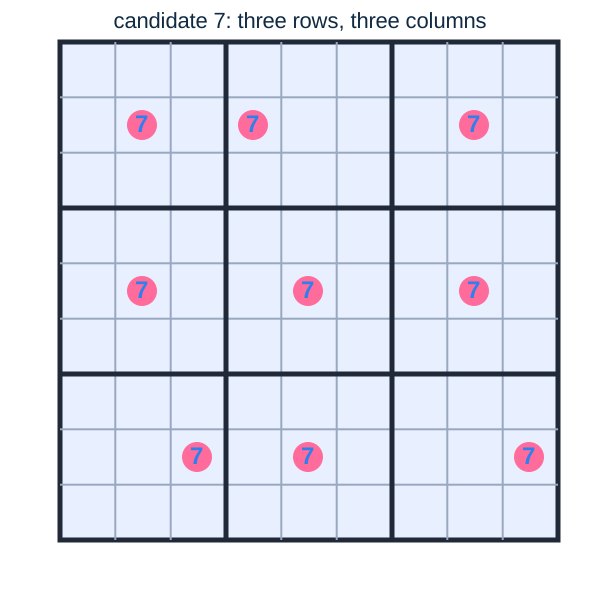
Swordfish is a fish technique that extends the two-row or two-column structure of X-Wing to three base units. For one candidate digit, each of three rows must contain that digit in no more than three positions, and all of those positions must fall within the same three columns. The column version works the same way with rows and columns exchanged.
The three rows are the base sets and the three columns are the cover sets. Across the three base rows, the candidate must occupy the three cover columns in some arrangement. It can therefore be removed from other cells in those three columns, outside the base rows.
How Swordfish Works in Rows
To find a row-based Swordfish:
- Choose one candidate digit.
- Find three rows where that digit appears in two or three candidate positions.
- Check whether all candidate positions in those rows are contained in the same three columns.
- Remove the chosen digit from other cells in those three columns.
Each row may use only two of the three columns. That is allowed: the important condition is that the combined candidate positions fit inside exactly three cover columns. Do not remove the candidate from the nine positions that belong to the three base rows themselves.
Why the Elimination Is Valid
Suppose candidate 7 is restricted to three rows and the combined positions are limited to columns 2, 5, and 8. Each of the three rows must place a 7 in one of those columns, and Sudoku allows only one 7 in each column. The three 7s therefore occupy the three cover columns as a set, even though their exact order is unknown.
Any other cell in columns 2, 5, or 8 cannot contain 7, because those columns must already receive their 7 from one of the three base rows. The elimination is valid whether the pattern is easy to see in rows or in its transposed column form.
Swordfish and X-Wing
An X-Wing uses two base rows and two cover columns. Swordfish uses three of each and allows each base row to have two or three candidate positions. A Swordfish is not required to contain every corner of a perfect rectangle, so it can be harder to spot than X-Wing. Start with X-Wing when the positions line up exactly, then check Swordfish when a candidate is distributed across three units.
Common Mistakes With Swordfish
- Do not combine different candidate digits into one Swordfish.
- The candidate positions must be contained in three cover units, not merely close to one another.
- Extra candidates in the three base rows do not automatically invalidate the pattern; only the selected digit matters.
- Eliminate only from cover units outside the base units.
Can Swordfish Be Used in Any Sudoku?
Yes. Swordfish is a general Sudoku logic pattern and does not depend on a particular digit. It is most useful after singles, subsets, and simpler intersections have reduced the candidate grid. Because it needs several accurate candidate lists, complete Notes make the pattern much easier to verify.
What Should I Study After Swordfish?
Review X-Wing to compare the two fish sizes, then explore Skyscraper for a different strong-link pattern. Players working on harder grids can later study Unique Rectangle and other advanced elimination families.